- Home
-
Solutions
By automation levelBy industryPlan your project
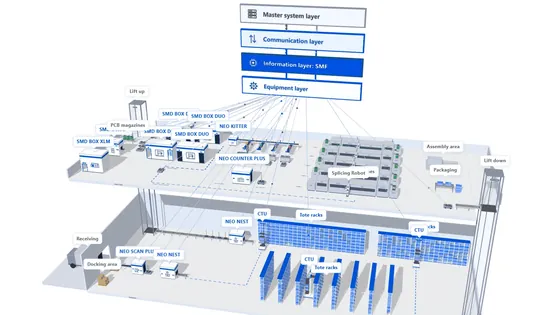 See the whole flow in 3DEnd-to-end SMT material handling, from goods-in to shipping.Watch the 3D flow →
- Products
- SMF Software
- KAI
- Service & Support
- About Neotel
- Blog
- Home
-
Solutions
- By automation level
- Semi-automatic
- Fully automatic
- Step by step
- End-to-end material handling
- By industry
- Automotive Electronics
- Consumer Electronics
- AI Servers
- Telecom/5G
- Medical Devices
- Industrial IoT
- Aerospace & Defense
- Plan your project
- ROI Calculator
- NEO STATION ROI Calculator
- AGV Fleet Sizing Calculator
- AGV Integration Guide
- Site Measurement Checklist
- All Solutions
-
Products
-
SMF Software
- KAI
-
Service & Support
-
About Neotel
- Blog
- Request a Quote
End-to-End SMT Material Handling:
From Goods-In to Shipping
Watch one connected material flow in 3D. Every reel is registered, stored, kitted, supplied to the line, counted on its way back and shipped as part of a finished product. Neotel machines do the physical work, and Neotel SMF software runs the whole flow.
What is end-to-end SMT material handling?
End-to-end SMT material handling means one system controls every material movement in an electronics factory: receiving and registering component reels, storing them, picking and kitting them per work order, supplying the SMT lines, counting and returning partly used reels, and moving finished goods back to the warehouse and out to the customer. In the Neotel approach, NEO SCAN gives every reel a unique ID at goods-in, racks with CTU robots and SMD BOX store it, kitting and AGVs bring it to the line, NEO COUNTER counts every return by X-ray, and Neotel SMF (Smart Material Flow) software connects all of these steps with your ERP and MES.
Watch the Material Flow in 3D
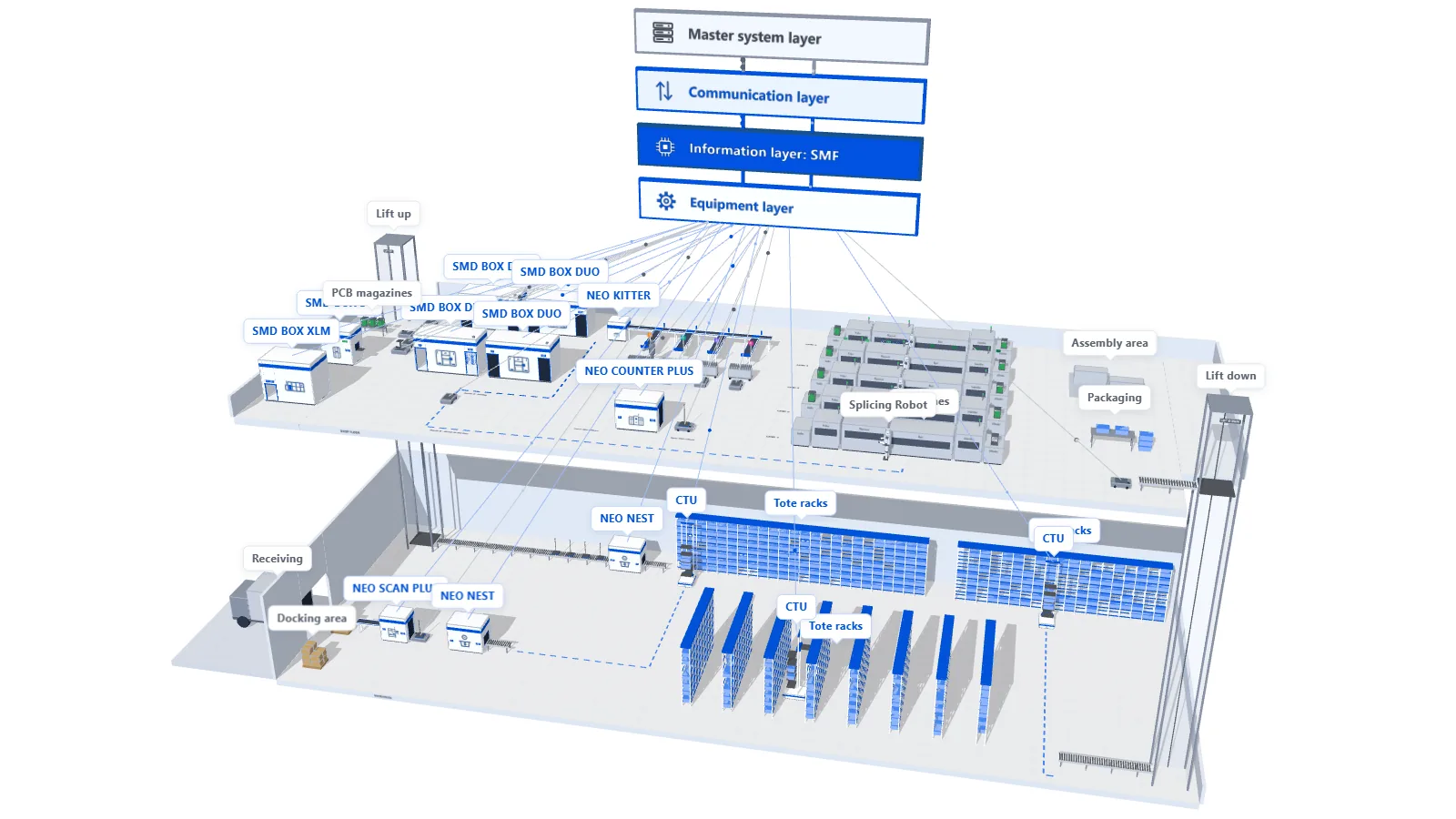
A schematic two-floor factory: the warehouse below, the shop floor above. Play it from start to finish, jump to any chapter, switch between floors, or click any machine to learn more.
How the Material Flow Works
The seven chapters of the animation, from the dock to the dock. Each step is run by Neotel SMF and done by a Neotel machine, an AGV or your own line.
Receiving and registration
Supplier reels are checked in at the dock. NEO SCAN PLUS reads every label and gives each reel a unique ID, so traceability starts at goods-in.
High-density storage
NEO NEST packs the registered reels into totes, and CTU robots store the totes on high racks. SMF knows the location of every reel.
Work orders: pick, sort and stack
Work orders arrive from your ERP or MES. The CTU retrieves the right totes, NEO NEST takes the reels out, and every reel is stacked per work order on a Neotel Stacker.
Line-side storage
A lift takes the full Stackers up to the shop floor. AGVs hand each Stacker in at the front of SMD BOX DUO, which stores every reel in its own slot.
Kitting and line supply
When the lines call for material, SMD BOX DUO issues complete kits through NEO KITTER, which sorts the reels into four lanes, one per work order. Single reels go straight to the line before a feeder runs out.
Production, returns and inline counting
A splicing robot joins each new reel on the run, so the line keeps going. Partly used reels pass inline through NEO COUNTER PLUS, are counted by X-ray and go back into storage with exact quantities.
Finished goods and shipping
Finished boards are buffered in SMD BOX XLM, go on to assembly and packaging, and ride the lift back down to the warehouse. The CTU stores them until the order ships from the dock.
Running in parallel: PCBs and solder paste
Bare PCBs in magazines are stored in SMD BOX XLM and issued to the line when the job needs them. Solder paste is kept cold in SMD BOX SP, warmed up in time and delivered to the printer by AGV.
One Software Runs the Whole Flow
Machines move the material. Neotel SMF decides what moves where and when, and keeps your enterprise systems up to date.
- Takes work orders from your ERP or MES through one API.
- Plans every material job and controls each connected Neotel machine.
- Sends transport jobs to your AGV fleet through its own fleet management software.
- Reports stock, consumption and job status back to your systems.
SMT Material Handling FAQ
Common questions about automating the material flow from goods-in to shipping.
Do I need every machine shown in the animation?
No. The animation shows a complete two-floor setup so the whole flow fits in one picture. Most factories start with the step that costs them most, for example reel registration, line-side storage or return counting, and add more over time. SMF runs fully automatic, semi-automatic or mixed setups.
Does SMF replace our ERP or MES?
No. Your ERP and MES stay the source of truth for orders, BOMs and master data. SMF receives the work orders through the API, runs the material jobs on the shop floor and reports stock, consumption and job status back.
Can SMF run without an MES?
Yes. SMF can work with an ERP only, or standalone with Neotel equipment.
Which AGVs or AMRs can be used?
Third-party AGV and AMR fleets connect through their own fleet management software. SMF sends the transport jobs to that software by API, and the fleet software dispatches the robots.
Is the factory in the animation a real installation?
No. It is a schematic example that shows the complete flow in one view. Machines are drawn as simple function boxes, and order numbers and quantities are example data. The layout for your project is planned with Neotel engineers.
Does SMF run on-premise or in the cloud?
Both are possible. SMF can be installed on servers in your factory or hosted in the cloud. The right choice depends on your IT policy, data-security requirements and how many sites you run.
Map This Flow onto Your Factory
Tell us about your warehouse, your lines and the systems you run. Our engineers show which steps to automate first and how SMF connects them.