- Home
-
Solutions
By automation levelBy industryPlan your project
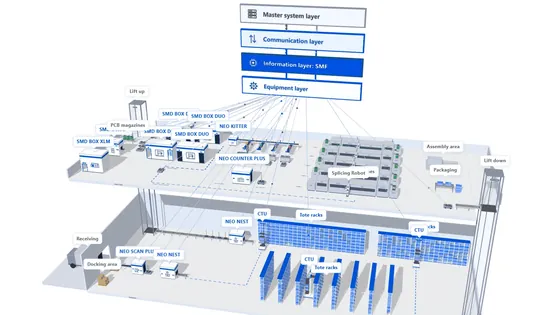 See the whole flow in 3DEnd-to-end SMT material handling, from goods-in to shipping.Watch the 3D flow →
- Products
- SMF Software
- KAI
- Service & Support
- About Neotel
- Blog
- Home
-
Solutions
- By automation level
- Semi-automatic
- Fully automatic
- Step by step
- End-to-end material handling
- By industry
- Automotive Electronics
- Consumer Electronics
- AI Servers
- Telecom/5G
- Medical Devices
- Industrial IoT
- Aerospace & Defense
- Plan your project
- ROI Calculator
- NEO STATION ROI Calculator
- AGV Fleet Sizing Calculator
- AGV Integration Guide
- Site Measurement Checklist
- All Solutions
-
Products
-
SMF Software
- KAI
-
Service & Support
-
About Neotel
- Blog
- Request a Quote
SMD BOX DUO
Dual-Module Automated SMD Reel Storage Tower
Two independent modules. Input and output in parallel. The SMD BOX DUO is a high-capacity automated reel storage tower that handles every reel directly — no cases or cassettes — storing over 4,000 standard reels and sustaining an output of 240 reels per hour per module (15 seconds per reel) — giving 2–4 production lines the throughput they need without the cost of a full-scale tower.
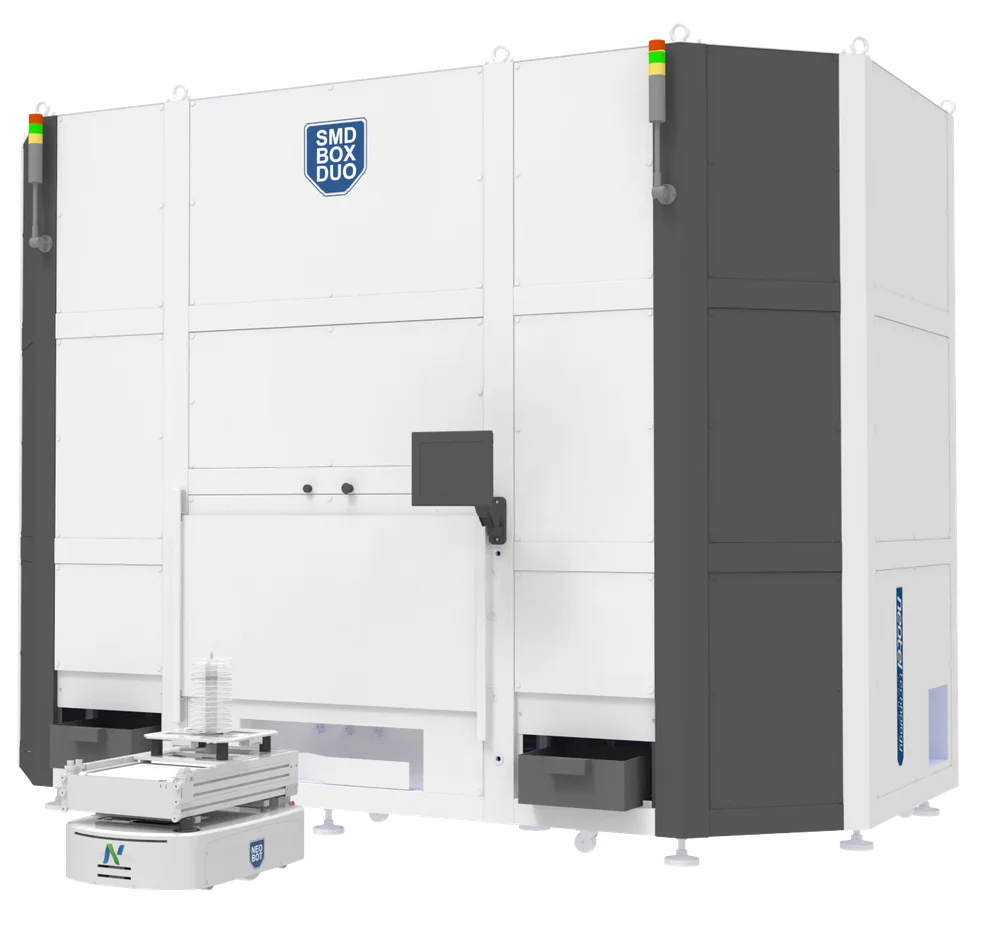
The Storage Core of Your Closed-Loop Material Workflow
The SMD BOX DUO covers three of the six steps in a closed-loop SMT material workflow: Storage (②), Retrieval (③), and Return (⑥). Reels go in after registration, come out by work order, and return to their slots after production — all automatically. Because both modules run in parallel, loading and picking happen at the same time, so one operation never blocks the other.
Assign unique ID
Climate-controlled storage
FIFO enforced
Ready-to-place delivery
Reconcile inventory
Reels and JEDEC Trays: How the DUO Handles Both
Reels arrive and leave on a stacker of up to 40 reels that docks directly at the DUO. JEDEC trays travel in a tray magazine: an operator loads it at the NEO SCAN table, where each tray ID is mapped to the magazine ID. Inside the DUO the SCARA robot and the module robots handle reels and trays one by one and store each in its own slot. The views show Layout 1 (rear input); Layout 2 works the same way through the shared front port.
Follow reel R-0001 and tray T-0041 from the stacker and the tray magazine into the slots, and out again. Select a step or a station to replay it.
Reels arrive on a stacker
Reels are stacked on a stacker that holds up to 40 reels. The full stacker docks directly at the DUO input, so nobody has to feed the reels in one at a time.
The DUO stores the reels one by one
The SCARA robot takes the reels from the stacker one at a time and hands each one to the middle position of module A or B, wherever a slot is free. The module robot then puts the reel in a free slot.
Trays go into a tray magazine and are mapped
JEDEC trays travel in a tray magazine, a flat rectangular holder for several trays. At the NEO SCAN table an operator loads the trays by hand, and NEO SCAN maps each tray ID to the magazine ID. The magazine then docks at the DUO input.
Trays are stored one by one, like reels
The SCARA robot takes the trays out of the magazine one at a time and passes each one to a module, whose robot stores it in a free slot.
Reels leave on a stacker, trays in a magazine
For a work order the module robots place reels on an output stacker and trays into a tray magazine. The stacker goes straight to your SMT line. The magazine goes back to the NEO SCAN table, where the trays are de-mapped from it before they go to the line.
Layout 1: Rear Input, Separate Output per Module
The SMD BOX DUO comes in two port layouts. In this one, reels go in at the back and come out at the front. A SCARA-type input robot between the two modules sends every reel to the middle position of module A or module B, depending on where a slot is free. Each module robot stores the reel in its ring of columns and later places it in the module’s own output, in the middle of the front side. Input and output never share a port, so all three robots work in parallel.
Layout 1: input at the rear, one output per module at the front. The top view shows the robots turning, the front view shows them moving up and down. Select a step or a module to replay it.
- Neotel robots and modules
- Reel R-0001 and live routes
- Storage positions
- Middle position (buffer)
- Your factory
Reels enter through the input at the rear
Reels registered at goods-in with NEO SCAN PLUS go into the input port at the back of the DUO. Reels coming back from the line after production use the same input. JEDEC trays come in the same way, in a mapped tray magazine, and reels can arrive on a stacker.
The SCARA robot sends the reel to module A or B
A SCARA-type input robot stands between the two modules. The system checks which module has a free slot, and the robot sends the reel to the middle position of that module, its buffer. Then it is free again for the next reel.
Robot A stores the reel while the next one comes in
Inside each module the storage columns stand in a circle around the module robot. Robot A takes the reel from the middle position, turns and puts it in a free column. Meanwhile the SCARA robot already sends the next reel to module B.
Robot B stores the reel in module B
Each module robot puts away its own reels, so the SCARA robot never waits for a storage move. Stock is spread across A and B, and one work order can later be picked by both robots.
A work order reserves reels in both modules
Neotel SMF software receives the work order from your ERP or MES and reserves its reels by position. Each module robot turns and moves to its own reels.
Robot A and robot B pick in parallel
Each module has its own output, in the middle of its column ring on the front side. Robot A and robot B take their reels from the columns and place them in their own output, 15 seconds per reel each. New reels keep arriving: the SCARA robot drops them at a module’s middle position, and the module robot puts them away as soon as it is free.
Reels go to the line on a stacker
Reels from the outputs on the front of modules A and B are stacked on a stacker that holds up to 40 reels, and the stacker is transported directly to your SMT line. After production, leftover reels come back to the rear input and start again at step 1.
Parallel Modules, Proven Throughput, Seamless Integration
The DUO is built around three strengths: dual-module parallel access, high-density mixed-reel storage, and plug-and-play connectivity with the systems and AGVs you already run.
- Input and output run in parallel across two independent modules — no waiting between operations
- 15 seconds per reel — a sustained 240 reels/hour output per module, so changeover kitting never stalls the line
- FIFO enforcement prevents expired or obsolete components from reaching production
- Holds 4,000+ reels (7" 8mm) in the standard configuration, with mixed-size storage
- Accepts 7–15" reels and JEDEC trays — every common SMT package format
- Reels are stored and picked directly — no cases or cassettes required
- Expandable tower height lets you add capacity without replacing the machine
- Runs on the SMF material management platform — work orders, MSD tracking, full traceability
- RESTful API and SQL interfaces connect directly to your ERP or MES
- Proven AGV integrations with MiR, Hikvision, Omron, and more
SMD BOX DUO Technical Specifications
Everything you need to evaluate the DUO for your facility — from power and air requirements to reel compatibility, retrieval speed, and certifications.
| Specification | SMD BOX DUO Specs |
|---|---|
| Operating Mode | Dual-module parallel access (DUO) — input, storage and output run in parallel |
| Robot Architecture | 3 robots — one shared SCARA input robot between the modules, plus one storage robot per module; the storage columns of each module stand in a circle around its robot |
| Port Layout | Two options: rear input + separate output per module at the front, or one shared input/output port at the front |
| Standard Capacity | 4,000+ reels (7" 8mm), mixed-size storage supported |
| Reel Compatibility | 7" / 13" / 15" SMT reels + JEDEC trays |
| Reel Handling | Direct individual reel handling — no cases or cassettes; reels arrive and leave on a stacker of up to 40 reels that docks at the DUO |
| Tray Handling | JEDEC trays travel in a tray magazine; tray IDs are mapped to the magazine ID at a NEO SCAN table, and the DUO stores each tray in its own slot |
| Retrieval Speed | 15 seconds per reel — 240 reels/hour sustained output per module; the separate input robot keeps storing while both modules pick |
| In/Out Strategy | FIFO (First In, First Out); work-order-based picking with batch traceability |
| Barcode Recognition | Reads all standard formats automatically (1D, 2D, Data Matrix) |
| Temp & Humidity Monitoring | Built-in temperature and humidity sensors with real-time dashboard |
| Humidity Control | Connect an external desiccator for ≤5% RH dry storage |
| MSD Management | SMF MSD module tracks Floor Life per IPC/JEDEC J-STD-033 |
| AGV Integration | Proven with MiR, Hikvision, Omron, Standard Robot, and others |
| System Integration | RESTful API / SQL for ERP, MES, and WMS connectivity |
| Software Platform | SMF — work orders, MSD tracking, material traceability, inventory analytics |
| Power Supply | 220V three-phase (standard factory supply) |
| Air Supply | 6 bar compressed air (87 psi) |
| Service Clearance | Rear 500mm (19.7") for service; with the rear-input layout, stackers and tray magazines also dock at the rear, so plan access behind the DUO |
| Operating Environment | Standard factory environment |
| Machine Height | 2,600 mm (102.4") |
| Certifications | Designed to comply with CE; manufactured under ISO 9001 / ISO 14001 (final certification confirmed per project and region) |
| Reliability | 5,000+ hours MTBF (mean time between failures) |
Dual-Module DUO vs. Single-Module Intelligent Storage Machines
Most automated SMD storage towers — often called intelligent storage machines (ISM) — run every insertion and extraction through a single robot inside one cabinet. The DUO’s twin-module architecture changes the math on throughput, uptime, and integration.
| Capability | SMD BOX DUO | Typical Single-Module Tower |
|---|---|---|
| Architecture | Two independent modules working in parallel | One robot shared by every insert and pick |
| Reel handling | Direct — every reel goes straight to its slot, no cases or cassettes | Reels must first be loaded into cases — the robot moves cases, not individual reels |
| Loading vs. picking | True parallel input + output — loading never blocks a kit retrieval | Input and output share one robot — one operation waits for the other |
| During maintenance | One module keeps feeding the line while the other is serviced | The entire tower goes offline |
| Sustained output | 240 reels/hour per module (15 s per reel), with input running in parallel | Output tied to case cycles that share one robot with input |
| Capacity (7″ 8mm reels) | 4,000+ | ~3,600 on the largest single towers |
| Package formats | 7″ / 13″ / 15″ reels + JEDEC trays in mixed storage | Reels only on many models |
| Published reliability | 5,000+ hours MTBF, stated openly | Rarely published |
| ERP / MES connectivity | Documented RESTful API + SQL — no middleware | Often proprietary or quote-only |
| AGV integration | MiR, Hikvision, Omron, Standard Robot — live at production sites | Limited or unpublished |
| Ecosystem | Closed loop from one vendor: scan → store → count → return | Storage only — you integrate the rest yourself |
| Climate monitoring | Included — temperature + RH sensors logged in SMF | Frequently a paid add-on |
Based on publicly available manufacturer datasheets for automated SMD storage towers in the 3,000–4,000 reel class, reviewed July 2026.
Evaluating the DUO against another storage tower? Send us the competing datasheet — we’ll map it spec-for-spec against the DUO for your line count and material mix.
Request a QuoteMoisture-Sensitive Device Management & Climate Control
MSDs need controlled storage from the moment they arrive. The DUO ships with built-in climate monitoring and supports an optional external desiccator for active dehumidification, while the SMF MSD module tracks Floor Life from receipt to placement.
- Built-in temperature and humidity sensors with real-time readings
- Automatic alerts when conditions drift outside acceptable thresholds
- Environmental data logged per reel batch for audit-ready traceability
- All data feeds into the SMF dashboard — no separate monitoring system needed
- Connect an external industrial desiccator for active dehumidification
- Achieves ≤5% RH, covering MSD Level 2a through 5a requirements
- SMF tracks Floor Life exposure time automatically across every reel
- Designed to comply with IPC/JEDEC J-STD-033
Connects to the Systems You Already Run
Standard APIs link the DUO to your ERP, MES, or WMS with no middleware. Add AGV transport and you get hands-free material flow from tower to pick-and-place machine.
What the DUO Means for Each Role on Your Team
Every stakeholder evaluates storage equipment through a different lens. Here is what the DUO delivers for each one.
Where You Will See the Impact
Based on results reported by existing customers. Actual figures vary with factory scale, line count, and material mix.
Trusted by Tier-1 Manufacturers Worldwide
Neotel systems run in 500+ factories across Europe, Asia, and the Americas, and the DUO is in production at Tier-1 EMS & OEM sites — backed by internationally recognized certifications.
Start Here, Scale When You Need To
The DUO sits in the sweet spot of the SMD BOX capacity lineup — enough throughput for most mid-size operations, with a clear upgrade path if your needs grow. Every model shares the same SMF platform and UID system, so scaling up never means starting over.
Small-scale lines
High throughput
Current Product
20,000-reel flagship
Assigns unique ID
Dual-module parallel tower
Ready for placement
Reconcile inventory
Is SMD BOX DUO Right for Your Factory?
Best fit
2–4 SMT lines that must load and pick at the same time — twin independent modules remove the single-hoist bottleneck.
Performance (as specified)
Dual-module simultaneous load/pick keeps lines fed without queueing; reels return to their slots automatically after production.
Deployment requirements
Built-in climate monitoring; optional external desiccator for active dehumidification when storing MSDs (SMF MSD module tracks Floor Life).
Integration
Standard RESTful API and SQL link to ERP/MES/WMS with no middleware — already running at Tier-1 sites with SAP, Oracle and custom MES; AGV-verified.
Support
Global support network: 7×24 coverage, 15+ service locations, 98% customer satisfaction. Confirm on-site coverage for your region with our team.
What shapes your quote
Line count, MSD share of inventory (desiccator option), AGV delivery scope, and ERP/MES interfaces.
Frequently Asked Questions
Answers to the questions we hear most from production managers, quality engineers, and IT teams evaluating the DUO.
DUO vs. MIMO — which one do I need?
When is the DUO the right fit?
What is the real-world advantage of two modules?
Can the DUO scale as our production grows?
Why is the DUO considered the best value in the lineup?
What reel sizes and package types does it accept?
How does humidity control work, and can the DUO meet MSD requirements?
What does the DUO need in terms of power, air, and floor space?
Which AGV brands are compatible, and how hard is the integration?
How does it connect to our ERP or MES?
How does the DUO compare with single-module intelligent storage machines?
How do reels and JEDEC trays get into the DUO?
Which port layouts are available?
How do reels and trays leave the DUO?
Not Sure Which Model Fits? Let's Figure It Out.
Tell us about your line count, material mix, and automation goals — our team will recommend the right SMD BOX configuration and send you a tailored proposal.