
What is SMT reel storage solution
What is SMT?
The reel storage solution is based on SMT technology, which stands for “surface mount technology,” a manufacturing process used to produce electronic devices and components. In SMT manufacturing, electronic components are placed directly onto the surface of a printed circuit board (PCB) and soldered in place rather than being inserted into holes in the PCB and soldered on the opposite side (a process known as through-hole technology).
SMT manufacturing offers several benefits over through-hole technology, including:
- Smaller components: SMT components are generally smaller than through-hole components, which allows for the production of smaller, more compact electronic devices.
- Higher component density: SMT allows for a higher component density on a PCB, which means more components can be placed in a smaller area.
- Faster manufacturing: SMT manufacturing is generally quicker than through-hole manufacturing, as the components do not need to be inserted into holes and soldered on the opposite side of the PCB.
- Greater accuracy: SMT manufacturing is generally more accurate than through-hole manufacturing, as the components are placed directly onto the PCB and soldered in place rather than inserted into holes and soldered on the opposite side.
- Lower production costs: SMT manufacturing is generally less labour-intensive than through-hole manufacturing, which can result in lower production costs.
What is an SMT reel?
SMT reels (surface mount technology reels) are used to hold and store electronic components used in the SMT (surface mount technology) manufacturing process. The specific specification of an SMT reel will depend on the size and type of components it is designed to hold, as well as the needs and preferences of the manufacturer. Here are some typical SMT reel specifications:
- Reel diameter: This refers to the reel’s outer diameter, typically measured in millimetres.
- Reel width: This refers to the width of the reel, which is typically measured in millimetres.
- Reel hole size: This refers to the size of the hole in the centre of the reel, typically measured in inches.
- Reel thickness: This refers to the thickness of the reel, which is typically measured in millimetres.
- Reel material: SMT reels can be made of various materials, including plastic, paper, and metal. The material used will depend on the type and size of the components being stored, as well as the intended use of the reel.
- Reel capacity: This refers to the number of components that the reel can hold, which is typically measured in terms of the number of components per reel or the total weight of the components.
- Reel orientation: This refers to the orientation of the components on the reel, which can be essential for ensuring that the components are correctly aligned and oriented on the production line.
- Reel leader and trailer: These are the ends of the reel that are used to guide the components onto the production line. The length and size of the leader and trailer can vary depending on the specific requirements of the manufacturer.

SMT reel storage solution
SMT reel storage solutions are typically designed to optimize space, improve efficiency, and protect the integrity of electronic components. They may include features such as:
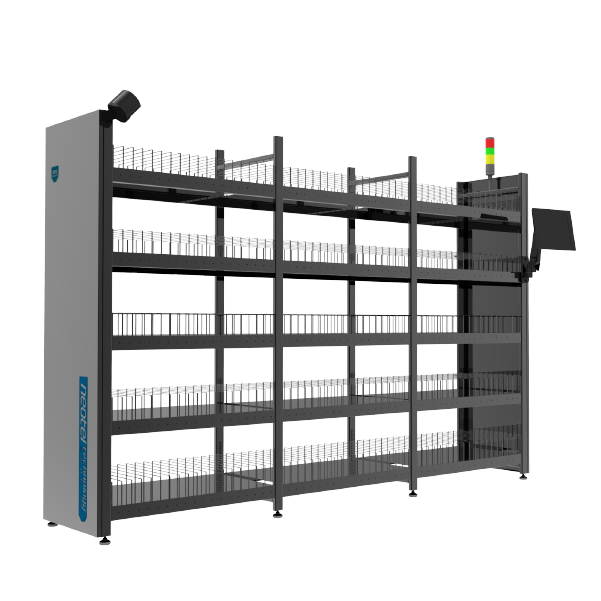


- Adjustable shelving: This allows companies to customize the storage layout to fit their specific needs and accommodate different sizes and types of reels.
- ESD (electrostatic discharge) protection: This helps prevent damage to the electronic components due to static electricity.
- Climate control: This helps maintain stable temperature and humidity conditions to prevent damage to the electronic components.
- Labelling and identification: This helps companies quickly identify and locate specific reels of components.
- Security features: This may include locks, alarms, or other measures to prevent unauthorized access or tampering with the stored components.
Modern SMT factories increasingly replace manual racks with automated storage. An SMD reel storage tower such as the Neotel SMD BOX DUO stores 4,000+ reels, retrieves any component in under 15 seconds, and enforces FIFO automatically — and the wider SMD BOX series scales from single-line shops to 20,000-reel operations.
Kitting
Kitting is the process of gathering and organizing the materials and components that are needed for a specific manufacturing process. In the context of SMT (surface mount technology) manufacturing, kitting for SMT reels involves gathering and organizing the electronic components that are contained on the reels and preparing them for use on the production line.
The kitting process for SMT reels typically involves the following steps:
- Verifying the inventory: The first step in the kitting process is to verify the inventory of SMT reels and ensure that all the necessary components are available. This may involve checking stock levels, placing orders for additional components, and tracking the progress of incoming shipments.
- Sorting and organizing the components: Once the inventory has been verified, the components contained on the SMT reels need to be sorted and organized according to their type, size, and orientation. This may involve separating different components, such as resistors and capacitors, and ensuring they are correctly oriented on the reels.
- Packaging and labelling the components: The sorted and organized components are then packaged and labelled according to the specific requirements of the manufacturing process. This may involve using moisture barrier bags and desiccants to protect the components from moisture and labelling the packages with information such as the type and quantity of components contained within.
- Storing the components: Once the components have been packaged and labelled, they must be stored securely until they are needed on the production line. This may involve using a storage system such as adjustable shelving or racks to organize and store the components in an efficient and easily accessible manner.
Job list/work order
A work order is a document that outlines the tasks and activities that need to be completed to produce a specific product or component. In the context of SMT (surface mount technology) production, a work order for SMT production may include the following information:

- Product or component details: The work order should specify the type and quantity of the product or component being produced, as well as any relevant specifications or requirements.
- Production schedule: The work order should include the expected start and end dates for the production process, as well as any intermediate deadlines or milestones.
- Raw materials and components: The work order should specify the raw materials and components that are required for the production process, including any necessary SMT reels and electronic components.
- Production process details: The work order should outline the specific steps and tasks that must be completed to produce the product or component, including any necessary setup and configuration of the SMT production line.
- Quality control: The work order should specify any measures that need to be taken during the production process, such as inspections and testing.
- Packaging and shipping: The work order should specify any packaging and shipping requirements for the finished product or component, including the desired shipping method and any special handling instructions.
- Contact information: The work order should include contact information for the person or team responsible for overseeing the production process, as well as any relevant stakeholders or customers.
Published · Updated