SMT Material Registration System NEO SCAN
Scan · Unique Identity · Full Traceability
Unregistered materials are a blind spot in warehouse management — impossible to trace origins, match work orders, or automate retrieval. The NEO SCAN material registration system establishes a unique digital identity (UID) for every incoming reel, enabling identification, traceability, and control from receiving to return. Two models cover semi-automatic to fully automatic operation, fitting small-batch manual receiving through large-scale unmanned production lines.
Starting Point of the Material Loop: All Traceability Begins with Registration
In the complete material loop from receiving to return, registration is the prerequisite for all automation. At the first step, NEO SCAN generates a unique ID (UID) for every reel, enabling precise tracking and intelligent scheduling across all downstream stages: storage, retrieval, counting, and return.
Generate unique digital identity
stored in smart storage
FIFO automatically enforced
Your production line
Update inventory records
Two Registration Systems: Semi-Automatic vs. Fully Automatic
NEO SCAN offers two automation levels — semi-automatic for small-to-medium lines with manual receiving, and fully automatic for large-scale unmanned lines with AGV integration. Both generate UIDs in the same format, seamlessly recognized by all downstream equipment.
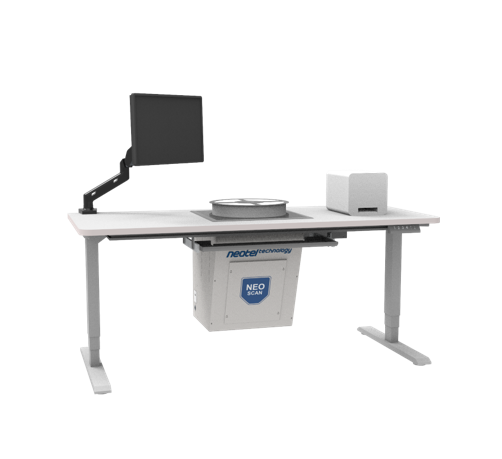
- Reads barcode + printed text (OCR) on every reel — 99.8% recognition, even on non-standard labels
- Cross-references supplier data to your ERP part number and auto-issues a UID
- Delivery-note / ASN check flags shortages and wrong parts at receiving
- Poka-yoke post-print check + a 20MP audit image archived per reel
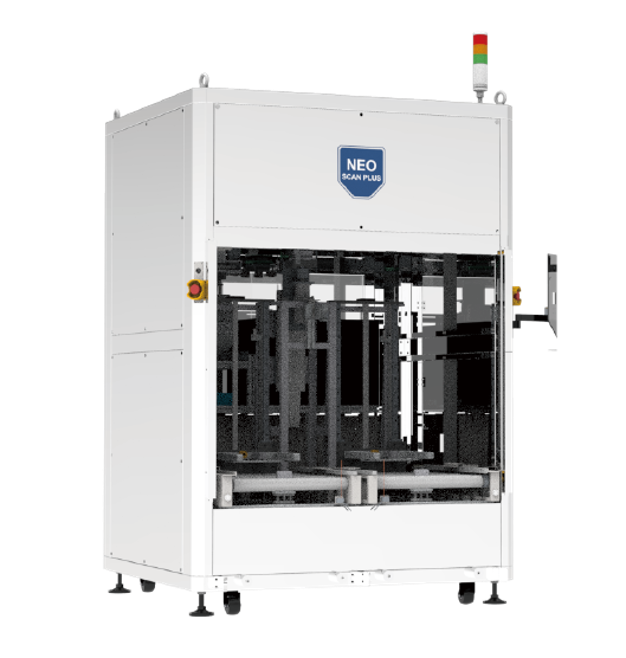
- AGV-fed loading, industrial camera auto-reads barcodes
- Auto-generates UID + auto-prints label + auto-applies label
- Labeling accuracy ±0.1mm, zero manual intervention
- Integrates with ERP/MES/WMS/AGV for end-to-end automation
Key Specifications: NEO SCAN vs. NEO SCAN PLUS
The table below helps you quickly compare the core differences between NEO SCAN and NEO SCAN PLUS. Choose the right model based on your line scale and automation requirements.
| Comparison | NEO SCAN | NEO SCAN PLUS |
|---|---|---|
| Automation Level | Semi-automatic (manual operation) | Fully automatic (unmanned operation) |
| Loading Method | Manual reel-by-reel placement | AGV automatic feeding |
| Barcode Reading | Handheld scanner, manual scan | Industrial camera, auto-recognition |
| Unique ID (UID) Generation | ✓ Auto-generated | ✓ Auto-generated |
| Auto-Labeling | — (manual labeling) | ✓ Auto-print + auto-apply |
| Labeling Accuracy | — | ±0.1mm |
| Barcode + OCR Capture | ✓ 99.8% recognition | ✓ 99.8% recognition |
| Delivery-Note / ASN Verification | ✓ Reconcile vs. PO / ASN | ✓ Reconcile vs. PO / ASN |
| DateCode Translation | ✓ Any format → usable date | ✓ Any format → usable date |
| 20MP Image Archive per Reel | ✓ | ✓ |
| System Integration | ERP / MES | ERP / MES / WMS / AGV |
| Paired Storage | NEO LIGHT | SMD BOX |
| Paired Counter | NEO COUNTER X400 | NEO COUNTER X800 |
| Typical Use Case | Small-to-medium batch, manual receiving lines | High-volume lines, unmanned warehousing |
After Registration, Where Do Materials Go?
After registration, materials enter the storage stage. Depending on your chosen automation route, NEO SCAN naturally connects to the corresponding downstream equipment, with registration data flowing throughout the entire loop.
After NEO SCAN PLUS completes registration and labeling, materials are automatically transported by AGV into SMD BOX. Subsequent retrieval, counting, and return are fully unmanned.
- Register: NEO SCAN PLUS auto-scans and labels
- Store / Retrieve / Return: SMD BOX
- Count: NEO COUNTER X800
After NEO SCAN completes scanning and registration, operators place materials into NEO LIGHT. Light-guided picking and sensor-confirmed placement enable efficient human-machine collaboration.
- Register: NEO SCAN manual scan registration
- Store / Retrieve / Return: NEO LIGHT
- Count: NEO COUNTER X400
Frequently Asked Questions About SMT Barcode Scanning
Answers to common questions about SMD reel scanners, material registration, and incoming inspection for SMT manufacturing.
What is an SMD reel scanner?
How does SMT incoming inspection work with NEO SCAN?
What is component registration in SMT manufacturing?
What is the difference between NEO SCAN and NEO SCAN PLUS?
Can NEO SCAN verify a delivery against the purchase order?
Choose the Right Registration Solution for Your Line
Not sure whether to choose NEO SCAN or NEO SCAN PLUS? Our solution consultants will recommend the best-fit registration system based on your line scale, material types, and automation goals.