How Much Does a Pick to Light System Cost?
Warehouse pick to light deployments are priced per light-directed location installed, scaling from single-zone starter kits up to large multi-zone distribution systems that are major capital projects. In electronics manufacturing the math is different: pick to light is usually bought per rack, not per location — a smart reel rack concentrates over a thousand LED-guided slots in a single frame, so the cost per location drops to a small fraction of a warehouse deployment.
One honest caveat up front: every serious vendor quotes pick to light system cost against your slot count, software scope, and integration needs. There is no meaningful list price — use this guide to understand what moves the quote.
What Drives Pick to Light System Cost
- Number of pick locations. The dominant driver. Each location needs an LED module (or a module shared across a shelf segment), wiring, and a slot in the controller map.
- Display and sensor type. Simple single-color LEDs cost the least; RGB modules, digit displays, and put-confirmation sensors raise the per-location price but cut errors further.
- Controller and software. Zone controllers plus the pick-to-light software license. Some vendors price software per seat, some per zone, some bundle it with hardware.
- Integration. Connecting to your WMS, MES, or ERP — work-order import, inventory write-back, user management. Often quoted as an engineering line item.
- Installation and training. Racking changes, cabling, commissioning, and operator onboarding. Light-duty rack systems can be near plug-and-play; conveyor-integrated zones are not.
Pick to Light System in Manufacturing vs. the Warehouse
Most published pricing describes warehouse order fulfillment — long pick faces, conveyor zones, wave picking. A pick to light system in manufacturing, and in SMT electronics in particular, has a different shape:
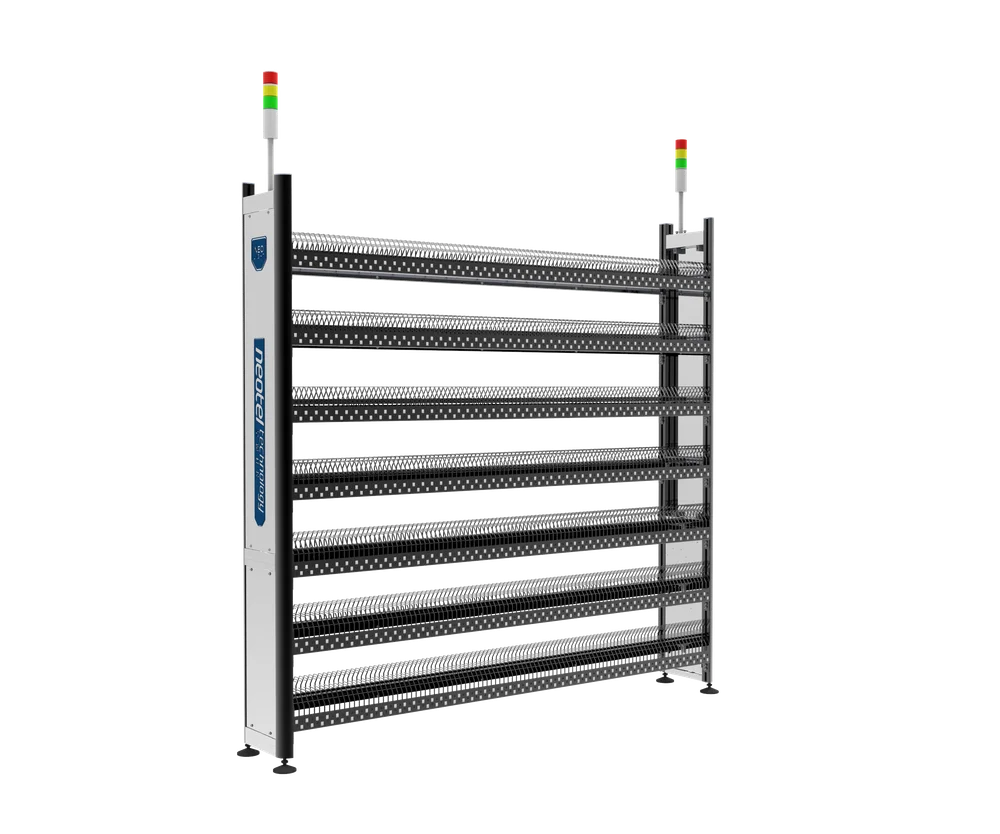
- Density. An SMT smart reel rack such as NEO LIGHT PTL packs about 1,400 LED-guided reel slots into one rack footprint. Buying that capacity as warehouse pick faces would cost many times more.
- Material identity. Reels carry unique IDs, lot codes, MSL ratings, and remaining quantities. The light system must track which reel is in a slot, not just how many pieces are in a bin.
- ESD construction. Racks, bins, and surfaces must be grounded and conductive — standard in SMT-grade systems, an upcharge in warehouse hardware.
- Line-side workflow. Kitting to feeders and returning partial reels after a run — the workflow the NEO LIGHT family is built around.
Typical Cost Tiers
| Tier | What you get | Budget signal |
|---|---|---|
| Starter warehouse kit (one zone, ~100 locations) | Basic LED modules, one controller, standalone software | Entry-level project |
| Multi-zone warehouse PTL | Thousands of locations, conveyor logic, WMS integration | Major capital project |
| SMT smart reel rack (pick to light) | ~1,400 LED slots per rack, ESD construction, MES/ERP sync via SMF software | Per-rack pricing — request a quote |
| Sensor-upgraded smart rack | Adds automatic pick/put confirmation sensors (e.g. NEO LIGHT Plus) | Step up per rack |
| Full automation | Robotic storage tower with automatic retrieval (SMD BOX) | Capital project — see the SMD storage tower cost guide and the ROI calculator |
The ROI Side of the Equation
Cost only makes sense against what manual storage already costs you. Three numbers dominate the payback calculation:
- Search time. Operators spend 30–45 seconds finding a reel on manual shelving; LED guidance cuts that to about 3 seconds. Across hundreds of picks per shift, that is an operator-hour recovered every day, per rack.
- Picking errors. A wrong reel that reaches a feeder means rework or scrap. Light guidance plus barcode confirmation pushes accuracy to near 100%.
- Lost material. Misplaced reels quietly become repurchases. We worked through that arithmetic in The True Cost of Missing Reels.
At medium SMT volumes, rack-level pick to light typically pays for itself quickly — fastest where error costs are high. Run your own numbers in the smart material handling ROI calculator.
How to Budget a Pilot
- Count locations honestly. How many reels (or bins) need guided storage at the line today — not in the five-year plan.
- Start with one rack or one zone. A single smart reel rack is a self-contained pilot: no racking rebuild, no conveyor work.
- Measure two weeks of baseline first. Picks per hour and picking errors before installation — that baseline is what proves the ROI afterwards.
- Decide the integration depth. Standalone operation is cheapest; MES/ERP-connected inventory sync is where the strategic value is. Price both.
Frequently Asked Questions
How much does a pick to light system cost?
Warehouse deployments are quoted per pick location installed, so the total scales with location count. In SMT manufacturing, pick to light smart reel racks are priced per rack (around 1,400 LED-guided slots each), which brings the cost per location far below warehouse deployments. Exact pricing depends on slot count, sensors, software, and integration scope — which is why vendors quote per configuration.
Why don’t vendors publish pick to light prices?
Because two systems with the same name can differ by an order of magnitude: location count, LED versus sensor-verified modules, software licensing model, and WMS/MES integration effort all move the total. Reputable vendors quote against a defined slot count and integration scope — which is also the only number you can actually compare.
Is pick to light worth it for a small SMT line?
Usually yes, because the entry point is one rack, not a warehouse project. A single LED-guided reel rack removes the 30–45 second search time per pick and most picking errors immediately, and it keeps working as a line-side kitting station if you later add automated storage.
How does pick to light cost compare with full automation?
A pick to light rack is typically a small fraction of the cost of a robotic storage tower, because it keeps the human in the loop instead of automating retrieval. Many factories run both: towers as the central warehouse, pick to light racks line-side. If you are weighing the two, model them in an ROI calculator rather than comparing list prices.