
Why Material Flow Breaks First
Ask where production time goes and most answers point at machines. Measure it, and a different culprit appears: material flow problems in manufacturing — the time materials spend being found, counted, kitted, moved, and argued about. Machines are instrumented; the spaces between them usually are not. That gap is where hours leak.
Below are the seven failure points we see most often in SMT factories, and what actually fixes each one.
The 7 Failure Points
1. Materials nobody can find
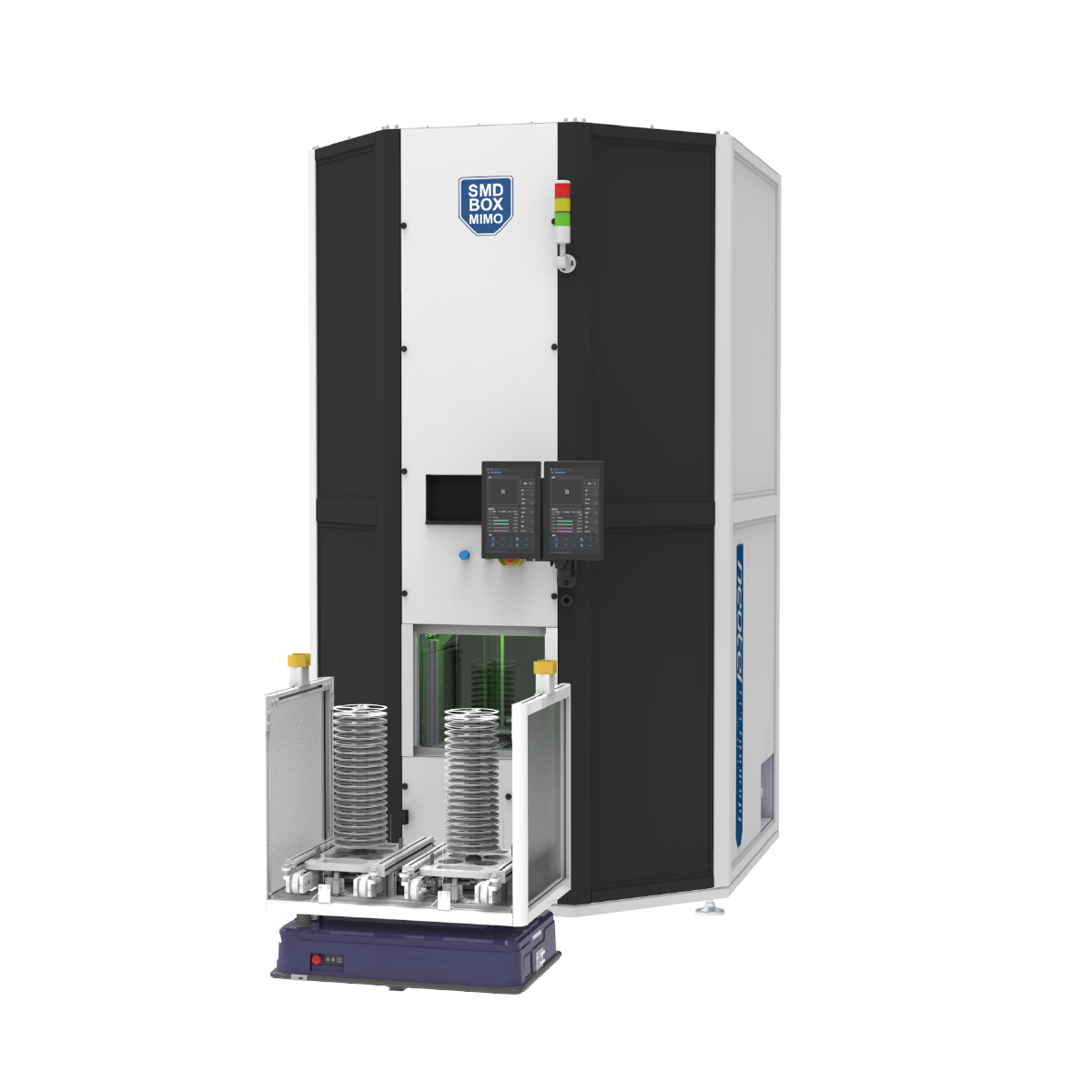
A work order starts, the reel exists in the ERP, and an operator spends 30–45 seconds per reel walking shelves — or twenty minutes when it was put back in the wrong place. Fix: location-tracked storage, whether an automated tower or an LED-guided rack, so “where is it” is a database query, not a search party.
2. Inventory records that drift from reality
Every manual touch — an unlogged withdrawal, an estimated partial reel — nudges records away from physical truth, until purchasing buys parts you own and production trusts stock you don’t have. Fix: count material at the loop’s natural checkpoint, after production: an X-ray reel counter writes verified quantities back automatically.
3. No FIFO discipline
When operators grab the nearest reel, the oldest stock ages at the back of the shelf — a direct problem for date-coded materials. Fix: let the system choose the reel. FIFO enforced by software costs nothing once picking is guided.
4. Unmanaged moisture exposure
MSD components have a floor-life clock that manual logs track badly. One missed entry and a tray of BGAs becomes a re-bake decision — or a field failure. Fix: dry storage with automatic floor-life tracking, so exposure time is recorded by the equipment, not the operator.
5. Slow, error-prone kitting
Kitting a changeover from paper lists is the classic bottleneck: long, late, and occasionally wrong — and a wrong reel on a feeder is rework downstream. Fix: work-order-driven picking. The work order arrives digitally; storage presents or lights up exactly the reels it needs.
6. Partial reels that vanish after the run
Leftover material comes back with a guessed quantity on a sticky label, or doesn’t come back at all. We did the arithmetic on this one in The True Cost of Missing Reels. Fix: count-then-return as a standard step, so leftovers re-enter stock with verified quantities.
7. No trace when something goes wrong
A component lot is recalled, a board fails in the field — and answering “which boards used that lot?” takes days of spreadsheet archaeology. Fix: lot-level traceability recorded as a by-product of normal material flow, the way SMT material management software does it — not as a separate clerical task.
Material Flow Systems in Manufacturing: the Closed Loop
Notice the pattern: every fix turns a physical movement into a data event. That is what material flow systems in manufacturing do when they work — registration gives each reel an identity, storage gives it a location, picking ties it to a work order, counting verifies what remains, return closes the loop. Six steps, each one recorded.
You don’t need to deploy all six at once. Each failure point above stands alone, and each fix delivers its own savings. The factories that get manufacturing material flow right usually started with their single worst pain point — most often reel search or inventory drift — and let the loop grow from there.
Where to Start
- Measure one week of search time. Have operators tally minutes spent locating materials. This number funds the business case.
- Audit record accuracy. Cycle-count 100 reels against the ERP. The gap is your inventory drift, in parts and dollars.
- Fix the worst failure point first. Then connect the next step of the loop when the first one has paid for itself.
Frequently Asked Questions
What are the most common material flow problems in manufacturing?
Materials that cannot be found at work-order start, inventory records that disagree with the shelf, no FIFO discipline, unmanaged moisture exposure, slow manual kitting, partial reels lost after production, and missing lot traceability. Most share one root cause: material movements that never become data.
What is a material flow system in manufacturing?
The combination of storage equipment, identification (barcode/RFID), and software that moves materials through receiving, storage, kitting, production, and return — recording every step. In SMT, that means registration scanners, smart storage, and material management software connected to MES/ERP.
How do you improve material flow in an SMT factory?
Measure where time is lost, then close the loop step by step: unique IDs at registration, location-tracked storage, work-order-driven picking, counting before return. Every step that becomes data removes a place where flow silently breaks.