Neotel Technology
● Scenario Line · Container-Level Materials

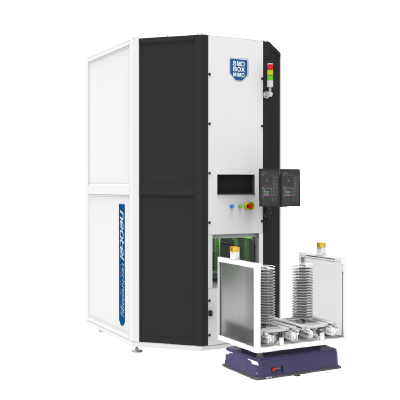
SMD BOX XLC
Automated Container Handling System

SMD BOX XLC brings totes, bins, and boxed materials into the smart storage ecosystem, enabling fully automated container-level storage, retrieval, and traceability. Paired with XLR reel-level storage, it covers every material form factor from reels to totes, building a complete intelligent warehousing architecture.
Container
Level Management
Full Auto
Store & Retrieve
XLR
Complementary
AGV
Unmanned Docking
SMD BOX XLC Automated Container Handling System - Neotel Technology
MATERIAL LOOP

The Storage Hub: Container-Level Automated Storage Across Three Steps

SMD BOX XLC handles Storage (Step 2), Retrieval (Step 3), and Return (Step 6) in the material loop — containers are automatically stored after registration, precisely retrieved by work order, and remaining materials are returned to their slots after production. Bringing container-level materials into the same closed-loop system as reels.

1
Register
Scan incoming barcodes
Create digital identity
NEO SCAN PLUS
2
Store
Auto container storage
Smart slot management
SMD BOX XLC
3
Retrieve
Work order picking
FIFO compliance
SMD BOX XLC
4
Production
Material Ready
Seamless line integration
Powering Your Production
5
Count
X-ray counting of
remaining quantities
NEO COUNTER X800
Step 6 — Return: Remaining container materials after production are automatically returned to SMD BOX XLC → back to Step 2, ready for the next retrieval cycle
3/6

The Storage Hub Across Three Steps — Store · Retrieve · Return

SMD BOX XLC handles Storage (Step 2), Retrieval (Step 3), and Return (Step 6) in the material loop, bringing container-level materials into the same fully automated closed-loop system as reels.

CORE CAPABILITIES

Fully Automated Container Management — Completing the Storage Picture

SMD BOX XLC extends SMD BOX storage capabilities across three dimensions: container-level storage, full form-factor coverage, and unified platform management, ensuring closed-loop control from reels to totes.

📦
Automated Container Storage
  • Fully automated storage and retrieval of totes, bins, and boxed materials
  • Auto-identifies container barcodes/RFID for precise slot positioning
  • FIFO strategy ensures material shelf-life compliance
Container-Level Full Automation
🔄
XLC + XLR Full Form-Factor Coverage
  • XLC manages totes and bins; XLR manages reels and tape
  • Complementary pairing covers all material packaging types
  • Unified UID system enables seamless cross-device traceability
Reels + Containers Covered
🔗
Unified SMF Platform
  • Reel-level and container-level inventory managed on a single SMF platform
  • Supports work order kitting, material traceability, and inventory audits
  • AGV integration for end-to-end process automation
Seamless ERP/MES Integration
SPECIFICATIONS

SMD BOX XLC Technical Specifications

Purpose-built automated storage system for container-level materials, compatible with multiple tote sizes. Complements XLR reel storage to form a complete warehousing architecture.

Parameter SMD BOX XLC Specification
Storage Type Totes / Bins, fully automated container-level management
Container Sizes Supports multiple standard tote dimensions, customizable to fit
Storage Capacity Configurable by container size, high-capacity container storage
Identification Compatible with barcode / QR code / RFID, auto-identifies container identity
Retrieval Strategy FIFO, supports work order-based precision picking
System Integration AGV docking, supports RESTful API / Direct SQL
Complementary Architecture Paired with SMD BOX XLR for full reel + container coverage
Software Platform SMF Smart Material Control Platform (work order management, inventory traceability, unified control)
Power Supply 220V standard power
ECOSYSTEM

XLC + XLR Complementary Architecture — All Material Form Factors Covered

SMD BOX XLC and XLR form a complementary pair — XLR handles reel and tape-level storage while XLC handles tote and bin-level storage. Together on the SMF platform, they provide unified management across every material packaging type.

💡
Complementary architecture: SMD BOX XLR manages reel and tape-level materials (7–15 inch), while SMD BOX XLC manages totes and bins. Both share the SMF platform and UID system for seamless data interoperability, forming a complete smart storage solution from reels to containers. Learn about SMD BOX XLR →
Register
NEO SCAN PLUS
Fully automatic scanning
UID creation
Current Product
SMD BOX XLC
Store · Retrieve · Return
Container-level automation
Powering Your Production
Production
Material Ready
Seamless line integration
Counting
NEO COUNTER X800
X-ray counting
Inventory update
🔄
Semi-automatic alternative: For smaller production lines or budget-conscious operations, NEO LIGHT provides a light-guided semi-automatic storage solution at a lower investment to achieve smart warehousing.
FAQ

Frequently Asked Questions

Common questions about the SMD BOX XLC automated container handling system. For further inquiries, please contact our technical consultants.

What types of totes and bins does the XLC support?
SMD BOX XLC supports a wide range of standard totes and bins, including IC tray boxes, loose-component totes, PCB bins, and other container formats commonly used in SMT production. The system can be customized to accommodate your specific material packaging, ensuring all container-level materials are brought into the automated management system.
What is the difference between XLC and XLR? What does each manage?
The core difference lies in the material form factor each manages: SMD BOX XLR manages reel and tape-level materials (7–15 inch standard SMT reels), while XLC manages totes and bins (IC tray boxes, loose-component containers, and other non-reel packaging). Both share identical software platform, UID system, and closed-loop capabilities. Together they provide complete coverage of all material form factors.
When should I deploy both XLC and XLR together?
When your warehouse handles both reels/tape and totes/bins simultaneously, we recommend deploying XLC and XLR together. Typical scenarios include: SMT production floors with standard reel materials alongside IC tray boxes and loose-component containers, or receiving docks handling both taped and boxed incoming materials. Both units share the SMF platform for unified management and data interoperability — no need to maintain two separate systems.
Can the XLC be used independently without the XLR?
Absolutely. If your materials are primarily in tote and bin format (such as IC trays and loose-component boxes), deploying XLC alone fully meets your automated storage needs. XLC comes with the complete SMF platform, including work order management, inventory traceability, AGV integration, and all other capabilities. When you later need to manage reel materials, XLR can be added at any time to expand.
How does the XLC work with AGVs for automated container transport?
SMD BOX XLC integrates with AGV dispatch systems through the SMF platform. When a work order is issued, the system automatically generates container retrieval tasks. AGVs dock at the XLC output port to receive containers and deliver them to the designated production line stations. After production, AGVs transport remaining containers back to XLC for automated return. The entire process requires no manual handling, achieving end-to-end automation from warehouse to production line.

Plan Your Complete Material Storage Solution

Not sure if XLC is right for you? Our solution consultants will recommend the best SMD BOX combination based on your material types, warehouse scale, and automation goals.